
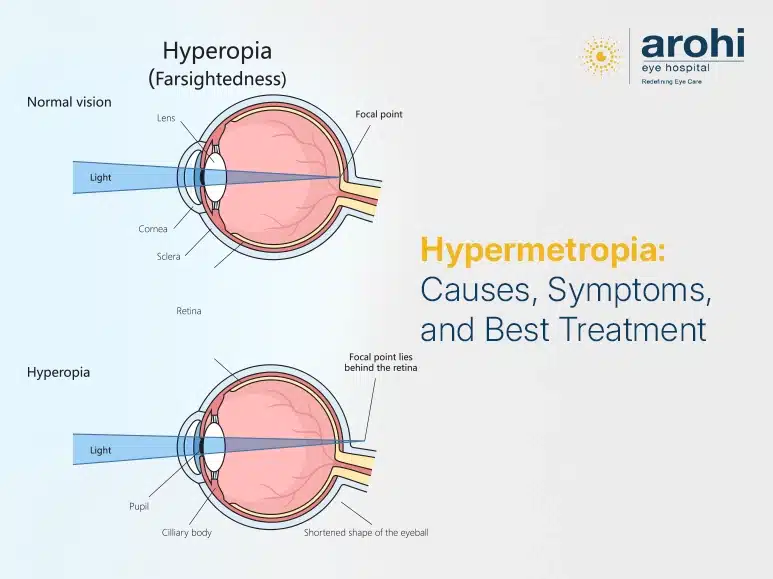
Hypermetropia is also known as farsightedness. It is a condition where you can read a distant signboard clearly but struggle to read a close object, the text on your mobile screen, or a restaurant menu. This happens because light entering the eye focuses behind the retina instead of directly on it, making near objects appear blurred while distance vision often remains relatively clear, especially in younger patients. Though common, uncorrected eye hypermetropia causes persistent eye strain, burning, and headaches, and in children, it may even lead to squint (strabismus) or lazy eye (amblyopia). At Arohi Eye Hospital, our eye specialists focus on precise diagnosis and advanced hypermetropia correction so that patients do not simply “manage” but actually enjoy relaxed, clear vision in daily life and love their life to the fullest.
The Core Causes: Why Hypermetropia Occurs
The hypermetropia occurs due to the structure of the eye, the cornea being flatter than usual, the lens having insufficient focusing ability, or the eyeball being too short from front to back. Below are some core hypermetropia causes mentioned:
1. Genetic Influence
For many people, especially children, the tendency is inherited. If parents or grandparents used a hypermetropia lens at an early age, their children often show a similar pattern. Genetics decide the eyeball length, the curve of the cornea, and how powerful the lens is, all factors that contribute to eye hypermetropia.
Get expert guidance to understand your vision problems and correct them
2. Shape of the Eyeball
A shorter eyeball is one of the most direct causes. Imagine projecting a movie onto a screen that is slightly too close; the image lands beyond the surface. The same thing happens here: light comes to focus behind the retina. A flatter cornea or a lens that doesn’t bend light adequately adds to the problem and eventually demands hypermetropia correction.
3. Age Differences: Children vs Adults
Children often start with mild hypermetropia, and it may gradually reduce due to eye growth. Adults, on the other hand, experience the lens becoming harder, and the vision at a distance requires more effort. Many patients at the age of about 35-40 start experiencing symptoms they never noticed before.
4. Risk Factors You Shouldn’t Ignore
A strong family history, excessive refractive errors, lifestyle habits such as excessive digital use, and systemic conditions such as diabetes can push the eyes into constant strain. In a city like Mumbai, where screens dominate commute time, work hours, and even free time, the accommodative stress is naturally greater.
Each of these hypermetropia causes eventually leads people to seek hypermetropia treatment in Mumbai, particularly when near tasks start affecting productivity or daily comfort.
Recognising the Signs: Common Hypermetropia Symptoms
Most patients describe the symptoms long before they learn the label for the condition. Watch for:
- Near tasks feel uncomfortable, such as reading, knitting, and phone use
- A burning or pulling sensation around the eyes after desk work
- Recurrent headaches, especially towards the evening
- The habit of squinting to sharpen vision
- In children: risk of strabismus (squint) or amblyopia (lazy eye), often missed until school age
These are the basic signs that it’s time to see a hypermetropia specialist in Mumbai for a detailed evaluation.
Best Treatment Options: From Temporary Fixes to Permanent Correction
At Arohi Eye Hospital, many patients often ask, “Do I have to wear glasses forever? The answer solely relies on the patient’s cornea, age, and level of error. Treatment is divided into conservative and advanced surgical procedures.
Conventional Management (The Temporary Fix)
- Spectacles
The most basic option involves the use of convex lenses to shift light onto the retina, with the primary lens used for hypermetropia. Glasses work immediately and are the safest and easiest to use for children.
- Contact Lenses
Most adults just use contacts because they are convenient and have a broader view. They require correct maintenance, particularly in Mumbai’s humid climate; however, they offer a comfortable alternative to glasses.
Advanced and Permanent Solutions (The Arohi Speciality)
When patients seek permanent farsightedness treatment, the team at Arohi evaluates suitability for refractive surgery through detailed corneal mapping and other precision tests.
1. LASIK and Its Advanced Forms
There are technologies such as Contoura Vision and Femto LASIK, which provide a personalised bladeless process. Contoura scans the surface of the eye with extraordinary detail, giving exceptional clarity, while Femto is a safer and quicker healing procedure. They are best suited to patients who want to recover as fast as possible with the highest level of accuracy.
2. PRK/TransPRK
A surface laser option suitable for thinner corneas. Healing is slightly longer than LASIK but equally effective in the right candidates.
3. ICL (Implantable Collamer Lens)
When corneal thickness or higher powers limit LASIK, ICL becomes the preferred choice. Many high-power patients at Arohi experience outstanding quality of vision with this procedure.
4. RLE – Refractive Lens Exchange
For older adults or those showing early signs of cataract, RLE replaces the natural lens with a customised artificial one, offering permanent clarity.
This spectrum of solutions ensures that patients searching for a hypermetropia doctor in Mumbai can find the best technology under one roof.
Why Expert Diagnosis and Personalised Treatment are Essential
Two patients with the same prescription can require completely different treatments. That’s why diagnosis is the backbone of Arohi’s care model. Using high-precision tools like Pentacam, Corneal Topography and Wavefront aberrometry, our specialists study every layer of the eye before recommending procedures like Contoura, PRK, or ICL.
This approach is not a one-size-fits-all philosophy; it is personalised, safety-first, and rooted in evidence for each individual.
Consult Mumbai’s Top Eye Specialists for Your Vision Correction
When eye strain or headaches become a regular part of your routine, don’t wait for the symptoms to intensify. A thorough consultation is the first step to bring back long-lasting clarity and comfort.
Arohi Eye Hospital, the best eye hospital in Mumbai for refractive errors, is an NABH-accredited centre with over 50,000 satisfied patients and is there for you with its professionalism and care. Whether you want to explore glasses or laser surgery options, the team will determine and ensure the decision aligns with what your eyes truly need.
Get expert guidance to understand your vision problems and correct them
Conclusion
Hypermetropia can seem minor initially, but its effect grows silently on your job, comfort, and your confidence in everyday life. The positive aspect is that all levels of farsightedness are manageable or corrected with the right approach. Whether you want to rely on glasses or explore advanced procedures such as Contoura, ICL, or RLE, timely evaluation can make all the difference. At Arohi Eye Hospital, we provide personalised care and accurate diagnosis to ensure that your eyes receive the attention they truly deserve.
Frequently Asked Questions
1. What happens if you have hypermetropia?
Near vision becomes difficult to see clearly, and the eyes overwork, which leads to strain.
2. At what age does hypermetropia occur?
It can be present from childhood or develop gradually with age.
3. Can you fix hypermetropia?
Yes, it can be fixed. Through glasses, contact lenses, or refractive surgeries like LASIK, PRK, ICL, or refractive lens exchange.
4. Does hypermetropia get worse with age?
It may progress as the lens stiffens, especially after the age of 40.
5. How can I prevent hypermetropia from worsening?
Regular checkups, visual breaks, and early correction help maintain stability.
Dr. Shradha Goel (CEO)
Dr. Shradha Goel, Chief Surgeon at Arohi Eye Hospital, is a renowned Phaco-LASIK surgeon with over 10,000 surgeries to her credit. She earned her MBBS from Grant Medical College, Mumbai, and a Master’s in Ophthalmology from Kasturba Medical College, Manipal. As a member of the American Academy of Ophthalmology, Dr. Goel specialises in LASIK, refractive errors, and cataract treatments.